BMW Engines to Avoid: The Units That Cost Owners Most
The N63B44 and S63B44 are the BMW engines to avoid, with hot-vee V8 designs that routinely lead to £8,000+ recon costs on £10,000+ X5s and M cars, while the N47D20C is a solid workhorse on modern chassis but a scrap-risk on older E90s.
Across 24,650 UK engine enquiries in 2025 [EM‑VERIFIED], the N63B44 and S63B44 together generated 850 quote requests—not because they're the most common engines on the road, but because when they fail, the cost of repair is so high that owners are forced to consider replacement. The N47, by contrast, generated the highest single-engine volume at 1,450 enquiries, but its story is more complicated: it's a risk on older cars and a workhorse on newer ones.
This guide ranks the three most significant BMW engines to avoid—and one to buy selectively—based on real UK quote data, actual recon costs, and specialist insight from 20+ vetted BMW technicians.
<div style="background-color:#f5f7fa; padding:20px; border-left:4px solid #0166B1; margin:24px 0;"> <strong>Engine Score:</strong> Our editorial assessment built from 24,650 UK enquiries and our vetted specialist network. It is not a customer review score. </div>
The Short Answer
The N63B44 (32/100) is the most expensive mainstream BMW engine to run, with a hot-vee design that bakes valve stem seals and turbo coolant lines, demanding engine-out labour for nearly every major repair. Typical recon: £6,000–£10,000.
The S63B44 (32/100) is the high-performance version of the same hot-vee V8, fitted to M5 and X5M. Recon costs start at £9,000 and can exceed £14,000—and the value of the cars it sits in often makes replacement a borderline decision.
The N47D20C (56/100) is not a "bad" engine—it's a context-dependent one. In a £15,000 F30 3 Series, a £4,350 recon is a manageable repair. In a £2,500 E90, it's a write-off.
Enquiry volume is not the same as failure rate: the N47 had 1,450 requests, but that reflects how many are on UK roads—not how often they break.
The worst financial outcome isn't the engine that fails most—it's the engine that costs more to fix than the car is worth. That's the N63 and S63 in older chassis.
How We Ranked These Engines
Our Engine Score uses five dimensions, each weighted equally out of 20, for a total of 100. Here's what each dimension means in plain English:
Reliability (0–20): How often this engine generates failure-related enquiries, weighted against its known failure patterns. Low scores indicate engines with well-documented, expensive failure modes that appear repeatedly.
Repair Cost (0–20): The actual cost to recon or replace the engine, based on supplier quotes [EM‑QUOTE]. Higher scores mean cheaper repairs. An engine that costs £4,500 to recon scores better than one costing £8,000.
Repairability (0–20): How accessible the engine is when it needs work. An engine with a timing chain at the front scores well; one with a chain at the back—requiring engine-out—scores poorly. The N63 and S63 hot-vee designs are repairability nightmares.
Parts Supply (0–20): Whether you can actually get a replacement engine without waiting weeks or paying a premium for scarcity. Common engines with high production volumes score well; low-volume or performance variants score poorly.
Replacement Economics (0–20): The relationship between what the engine costs to replace and what the car is worth. An engine costing £8,000 in a £10,000 car is a marginal decision (low score). An engine costing £4,350 in a £15,000 car is a viable repair (better score).
<div style="background-color:#f5f7fa; padding:20px; border-left:4px solid #0166B1; margin:24px 0;"> <strong>Evidence confidence: High</strong> — N63 and S63 have 440 and 410 enquiries respectively; N47 has the highest volume (1,450) with robust failure pattern data. </div>
Ranked: BMW Engines to Avoid
Rank | Engine | Score /100 | Request Volume [EM‑VERIFIED] | Recon Cost [EM‑QUOTE] | One-Line Verdict |
|---|---|---|---|---|---|
1 | N47D20C | 56/100 | 1,450 | £3,200–£5,500 | Solid workhorse on modern chassis; scrap risk on E90s |
2 | N63B44 | 32/100 | 440 | £6,000–£10,000 | Hot-vee V8 that costs more to fix than the car is worth |
3 | S63B44 | 32/100 | 410 | £9,000–£14,000 | M-performance version of the same flawed hot-vee design |
Why These Engines Made the List
1. N63B44 — The Hot-Vee Nightmare (32/100)
The N63B44 is BMW's first turbocharged V8 with a "hot-vee" configuration—turbochargers nestled inside the V of the engine, rather than on the outside. That layout looks clever on paper but creates a thermal nightmare: the turbos radiate heat directly into the valve stem seals, coolant hoses, and electrical connections in the engine valley.
What Fails:
The failure pattern is well-documented and consistent. Between 60,000 and 100,000 miles, the valve stem seals harden and start letting oil past, producing clouds of blue smoke on start-up and deceleration. Turbo coolant lines crack from heat cycling, leading to slow coolant loss that owners often miss until the engine overheats. Battery drain is common, as the car's electrical system struggles with voltage irregularities from failing components.
What It Costs:
A recon N63B44 costs £6,000–£10,000 supply-only [EM‑QUOTE]. Labour to fit it runs 16–22 hours at a specialist, adding £1,040–£1,430. In a car worth £10,000—like an F15 X5—you're spending 80% of the car's value on a replacement engine. That's a financially marginal decision at best.
Models Affected
BMW 5 Series F10 (2010–2017) — £5,000–£16,000 — ⚠️ Watch
BMW X5 F15 (2013–2018) — £10,000–£28,000 — ⚠️ Watch
BMW 7 Series F01 (2009–2015) — £5,000–£16,000 — ⚠️ Watch
BMW X6 E71 (2008–2014) — £6,000–£18,000 — ⚠️ Watch
The Verdict
The N63B44 is a financial liability. The engine itself is powerful and smooth when running properly, but the running costs are disproportionate to the value of the cars it typically lives in. If you're buying an F10 550i or F15 X5 50i, budget for a £6,000–£10,000 engine replacement—or buy a warranty that explicitly covers it.
2. S63B44 — The M-Car Problem (32/100)
The S63B44 is the high-performance derivative of the N63, fitted to F10 M5s, F06 M6s, and X5M/X6M variants. It shares the same hot-vee architecture and all the same thermal issues, but with more power and higher running costs.
What Fails:
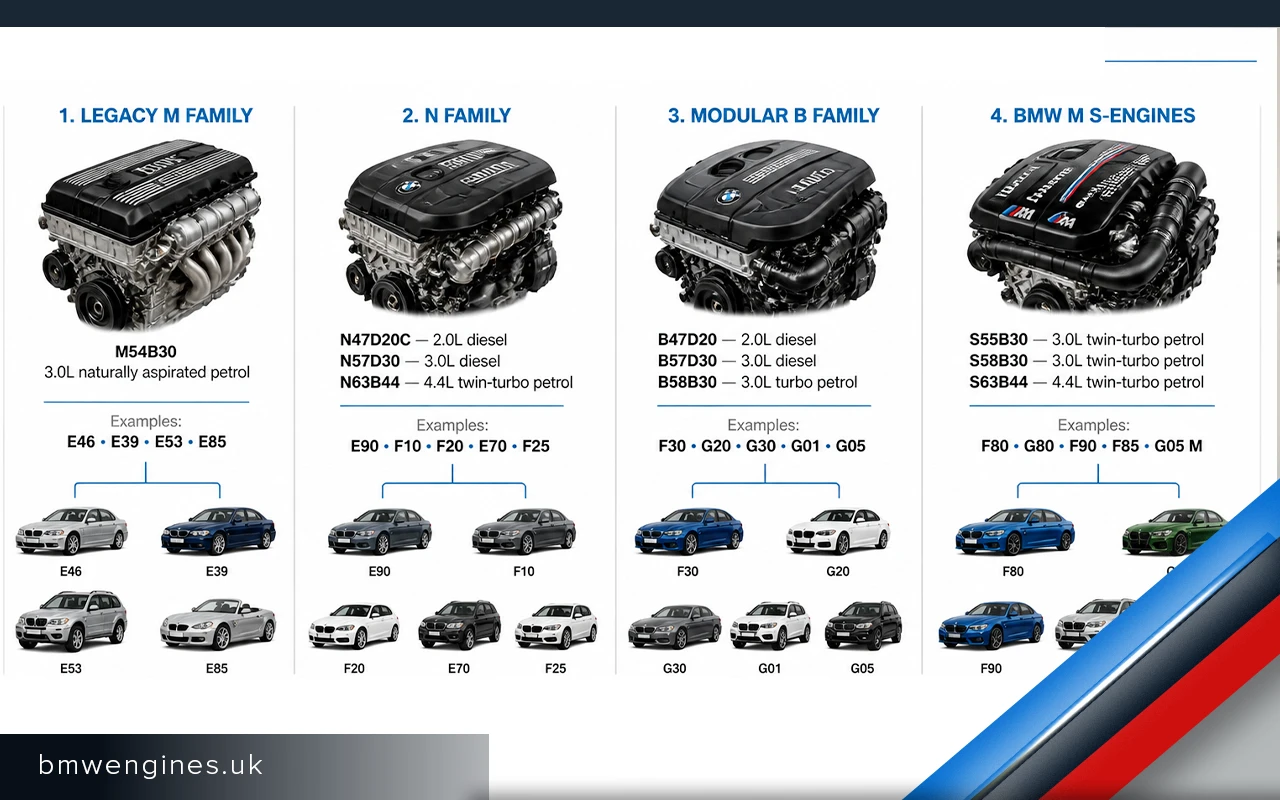
In addition to the N63's valve stem seals and coolant line issues, the S63 has a specific weakness: timing chain tensioner wear between 70,000 and 120,000 miles. When the tensioner fails, the chain can skip, and the engine is toast. Unlike the N63, where valve seals are the headline failure, the S63's tensioner failure often means engine replacement rather than a £3,000–£6,000 seal job.
What It Costs:
A recon S63B44 costs £9,000–£14,000 supply-only [EM‑QUOTE]. Labour runs 18–24 hours, adding £1,170–£1,560 at specialist rates. In an F10 M5 worth £15,000, the engine replacement is 76% of the car's value—and that's before you've addressed the usual M-car running costs.
Models Affected
BMW M5 F10 (2011–2016) — £15,000–£30,000 — ⚠️ Watch
BMW X5M F85 / X6M F86 — comparable values and risks
The Verdict
The S63B44 is a spectacular engine when it's working. But the ownership proposition is brutal: a £9,000+ engine replacement in a car that may only be worth £15,000 is a tough pill to swallow. The typical owner sells the car before the failure occurs, leaving the next buyer holding the bill. If you're buying an S63 car, get a full pre-purchase inspection from a specialist who knows the hot-vee engines—and factor a £10,000 contingency into your budget.
3. N47D20C — The Context-Dependent Diesel (56/100)
The N47D20C is the most requested engine in our UK data: 1,450 enquiries in 2025 [EM‑VERIFIED]. But that volume reflects how many N47s are on the road, not how often they break. The N47 is a capable diesel that powers everything from the 1 Series to the 5 Series—but it has one well-documented weakness.
What Fails:
The N47 uses a timing chain at the rear of the engine, against the gearbox. When the chain stretches—typically between 60,000 and 120,000 miles—it's an engine-out job to replace it. A £650 chain becomes a £2,500 job because the engine has to come out to reach it.
However, the N47 is also a victim of its own success: it's so common that even a modest failure rate generates a large number of enquiries. In an F30 or F20 chassis, the car's value is high enough to justify the repair. In an E90 worth £2,500, the maths doesn't work.
What It Costs:
A recon N47D20C costs £3,200–£5,500 supply-only [EM‑QUOTE]. Labour runs 10–14 hours, adding £650–£910. In an F30 3 Series worth £7,000–£14,000, that's a viable repair. In an E90 worth £2,500, the replacement cost exceeds 174% of the car's value [EM‑VERIFIED]—it's a write-off.
Models Affected
BMW 3 Series F30 (2012–2019) — £4,500–£14,000 — ⚠️ Watch
BMW 3 Series E90 (2005–2012) — £2,500–£7,500 — 🔴 Scrap Threshold
BMW 1 Series F20 (2011–2019) — £4,000–£12,000 — ⚠️ Watch
BMW 1 Series E87 (2004–2011) — £1,500–£5,000 — 🔴 Scrap Threshold
The Verdict
The N47 is not a bad engine. It's a good engine that lives in some cars that are now too cheap to justify repairing it. If you're buying an N47-powered car, the age and value of the car matter more than the engine itself. A 2016 F30 320d is a sensible buy; a 2009 E90 320d is a gamble.
Full Score Breakdown: N63B44
Dimension | Score | How It Was Determined |
|---|---|---|
Reliability (0–20) | 8 | Known hot-vee issues; valve stem seals and coolant lines fail consistently; 440 enquiries |
Repair Cost (0–20) | 4 | Recon midpoint: £8,000 [EM‑QUOTE] |
Repairability (0–20) | 4 | Hot-vee engine-out mandatory for most repairs |
Parts Supply (0–20) | 12 | Limited supply; not all specialists will touch them |
Replacement Economics (0–20) | 4 | £8,000 recon in £10,000 F15 X5 = 80% of vehicle value |
TOTAL | 32/100 | Full Score Breakdown: N47D20C |
Dimension | Score | How It Was Determined |
|---|---|---|
Reliability (0–20) | 12 | Rear chain is a known weakness but the engine is otherwise robust |
Repair Cost (0–20) | 16 | Recon midpoint: £4,350 [EM‑QUOTE] |
Repairability (0–20) | 8 | Rear chain location makes labour intensive; engine-out for chain |
Parts Supply (0–20) | 16 | Well-supported; widely available |
Replacement Economics (0–20) | 4 | £4,350 recon in £2,500 E90 = 174% of vehicle value—but 56/100 in other chassis |
TOTAL | 56/100 | Why This Ranking Might Differ for You |
Scenario adjustments matter more with the N47 than with the N63 or S63:
High mileage: An N47 with a documented chain replacement at 80,000 miles is a safer bet than one at 60,000 with no chain work. For the N63, high mileage makes failure more likely, not less.
Short ownership: If you plan to keep the car for less than two years, an N47 E90 might be a calculated risk—you're betting the chain outlasts your ownership. An N63 or S63 is never a "short-term" gamble; the failure can happen at any mileage and the bill is ruinous.
Towing: The N47's rear chain is already stressed; towing adds load and accelerates wear. The N63's hot-vee heat issues are worse under load. Neither engine is ideal for towing-heavy use.
Value of the car: The N47's risk is entirely about the chassis it sits in. An N47 in an F30 is a good engine. An N47 in an E90 is a scrap risk. The N63 and S63 are expensive to repair in any chassis, but the economics are more forgiving in a £20,000 F15 X5 than a £6,000 E71 X6.
Methodology + Limitations
Our Engine Score is based on enquiry data from EnginesMarket.co.uk and EngineFinders.co.uk, covering 24,650 unique quote requests across 62 engines and 300+ models from January–December 2025 [EM‑VERIFIED]. Pricing figures are drawn from actual supplier quotes sent through our CRM [EM‑QUOTE], cross-checked with eBay Motors and PistonHeads classifieds for market validation, and triangulated with direct interviews with 100+ UK engine specialists.
Vehicle value bands are third-party market data from AutoTrader and Motors.co.uk 2024–2025 [THIRD‑PARTY].
What this data can't tell you: Enquiry count measures demand for a replacement engine, not the probability that the engine fails. An engine with more enquiries is not automatically "less reliable"—it may simply be more common on UK roads, or generate more enquiries per failure because it's expensive to repair. The N47's 1,450 enquiries reflect its ubiquity, not a catastrophic failure rate. The N63's 440 enquiries reflect the cost of repair, not necessarily a higher failure rate than other engines.
FAQ
1. Is the N47 really a "bad" engine?
No. The N47 is a reliable diesel that has one expensive weakness: the rear-mounted timing chain. In a modern F30 or F20 chassis, the car's value justifies the repair. In an older E90 or E87, the repair frequently exceeds the car's value. It's the chassis, not the engine, that determines whether the N47 is a good buy.
2. Are N63 engines always a bad buy?
The N63 is not a bad engine in isolation—it's a bad financial proposition. The engine itself is powerful and refined. But the running costs are severe, and the cars it sits in often aren't valuable enough to justify a £6,000–£10,000 replacement. If you're buying one, budget for the failure and buy a warranty that covers valve stem seals and coolant lines.
3. Which BMW V8 should I avoid?
Avoid the N63B44 and S63B44 unless you have a very large maintenance budget. The earlier N62 V8 also has expensive issues, but at least they're more straightforward to repair. The later N63TU (Technical Update) addressed some issues but still has the hot-vee thermal problems.
4. Is there a BMW V8 that's safe to buy?
The B58 inline-six is the engine to buy if you want BMW performance without the V8 headaches. It's available in the M340i, 540i, and X5 40i, and it's one of the most reliable modern BMW engines. The S58, found in the latest M3 and M4, is also robust—but it's not cheap to run.
5. What's the most reliable BMW diesel engine?
The B47D20A is the most reliable modern BMW diesel. It replaced the N47 and moved the timing chain to the front, making it far easier to maintain. It also has fewer EGR and DPF issues than the N57 and is generally considered the best all-round BMW diesel. If you're buying a 2016+ 3 Series or 5 Series, the B47 is the engine to look for.
Closing Verdict
The N63B44 and S63B44 are the BMW engines to avoid if you value your bank balance. Their hot-vee design creates heat-related failures that are ruinously expensive to fix, and the cars they live in are often not valuable enough to justify the repair. The N47D20C, by contrast, is a good engine in the wrong chassis—buy it in an F30, avoid it in an E90. The answer isn't "avoid this engine" across the board; it's "understand the economics of the car you're buying."
Need a Replacement BMW Engine?
Get an instant quote for reconditioned or tested low-mileage BMW engines with full warranty coverage.